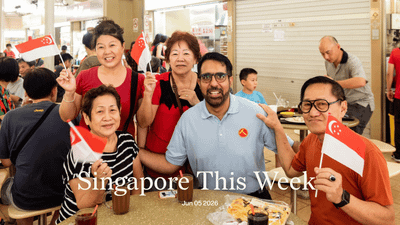
News this week included: SDP youth wing’s new council; WP’s Pritam Singh cheers HDB upgrading in Eunos; data confirms capital shifting from the Gulf to Singapore amid war; the Philanthropy Asia Summit; Singapore MRT reliability hits strongest level in nearly 18 months; OpenAI commits over S$300m to SG for its first Applied AI lab outside the US; Linda Lim on AI’s impact in the US; IMDA suspends Simba-M1 deal due to potential regulatory breach; H&M moves regional HQ from SG to MY; Meta cuts 8,000 jobs including over 100 in SG; online retailers flagged for unethical, deceptive practices; Amazon leaves SG e-commerce scene; CNA commentary on the prospects for South-east Asia’s budget carriers; deepfake footage of politicians in a S$4.9m government impersonation scam; construction worker dies at Cross Island Line worksite; ST commentary calling for better conditions for migrant workers; one active tuberculosis case (and here’s Jom’s writeup on TB); the Singapore doctor working in war zones like Gaza and Sudan; Tharman on SG becoming a “node” (guess we’re tired of “hub”) for regional artists; Ayaan, Ah Meng’s great-grandson, is our first primate conceived through assisted reproduction; a new species of deadly box jellyfish discovered here; the Asian openbills reshaping local ecology; bird deaths in Singapore hit record high; the Singapore Cricket Club’s facelift; K-pop robots; and Snow City to close after 26 years as Singapore’s first indoor snow attraction.
Below are the issues we explore in depth:
Society: Withdrawal symptoms
Look beyond the brightly lit towers of the Central Business District, or the manic “rat-race” of students scrambling over each other to secure the next resume-boosting internship, and a rather sobering pointillistic portrait of Singaporean society emerges. Follow these pressures to their logical endpoint and you understand how we arrived at the number that has now become a national obsession: 0.87, our total fertility rate (TFR). This isn’t a mere arithmetic problem to be resolved with baby bonuses and other incentives, for the ground reality points to something much more profound: a generation increasingly worn down by endless competition.
Across East Asia and beyond, a new lexicon has emerged to describe this fatigue. China has tangping, or “lying flat”: a quiet refusal of relentless striving. South Korea has the N-po generation, young adults giving up on milestones once considered non-negotiable, from marriage to home ownership. Japan’s hikikomori represents something more extreme— individuals withdrawing almost entirely from society. In other places, “quiet cracking” describes workers who continue performing while slowly burning out beneath the surface. All of these are simply different expressions for the same fracture: a gradual erosion of belief that effort guarantees reward.
Singapore, however, produces its own distinct variant of this exhaustion. Unlike larger countries where those who are fatigued could opt to move to rural areas or to vanish from economic competition, Singapore has few alternative spaces to disappear into. This is reinforced by socio-economic norms that rationalise intense competition throughout life, and by a meritocratic ethos that frowns upon failure as a personal shortcoming.
The result is that instead of “lying flat”, Singaporeans deal with exhaustion in subtler, quieter, and less tangible ways. It shows up in “quiet quitting”, in workers doing only what is required; in “job hugging”, where employees cling to roles they no longer believe in for fear of instability; in “revenge bedtime procrastination”, those stolen late-night hours reclaimed from lives otherwise governed by optimisation. If tangping is withdrawal through refusal, then Singapore’s version is withdrawal through calibrated detachment (a sort of functional disengagement, if you will): remaining visible, productive, and compliant, while steadily lowering their emotional investment in the race. Amidst such widespread “unease”, to borrow the title of sociologist Teo You Yenn’s new book that explores similar themes, it’s foolhardy to expect a flourishing TFR.
Are policymakers finally waking up to this? “Many people are not just asking, ‘Can we afford children?’ They are also asking, ‘What kind of life will we be able to give our children, and what kind of life will we have as parents?’” said Indranee Rajah, chair of the newly-formed Marriage & Parenthood Reset Workgroup. To arrive at an even remotely reassuring answer, an establishment wedded to relentless growth must interrogate not whether Singapore can sustain its model but whether individuals can sustain themselves within it.
Society: From coping to flourishing
Is mental health no longer a taboo topic? From the digital corridors of LinkedIn—leaders outdoing each other in vulnerability and our ever-expanding cache of wellness coaches—to the physical ones around town—workplace wellbeing initiatives and the multitude of mental health professionals opening new doors—Singaporean society now has some awareness of this plight of our modern condition. But beyond a recognition that the words “mental” and “health” can form a permissible duo, there’s much more work to be done to embed its vitality in society. This is the main takeaway from “From coping to flourishing”, a new citizen-led public consultation involving a survey of 525 people alongside a high-engagement subpanel of 23 people with lived experience of mental health issues.
A major finding is that less than half of respondents are aware of Singapore’s National Mental Health and Well-Being Strategy. (Among the strategy’s targets is for all polyclinics and 1,350 Healthier SG GP clinics to provide mental health services for common conditions by 2030.) Other findings include: only 15.2 percent of respondents are aware of “Beyond the Label”, our flagship anti-stigma campaign; fewer than half of respondents feel comfortable raising mental health concerns with their MP; and despite more visible workplace wellbeing initiatives, many respondents report overwork, emotional exhaustion, performance pressure, and fear of workplace consequences. “Help-seeking barriers are psychological, not informational,” said one respondent. “How is a Grab driver supposed to take [sic] mental health break without losing his income?” asked another. Several other groups may also feel underserved or underrepresented within current approaches, including caregivers, unemployed people, and LGBTQ communities. “Why are queer people actively written out of national policy?” asked a subpanel respondent.
“One of the clearest patterns emerging from the findings is that awareness alone does not necessarily translate into psychological safety, trust, or confidence in support systems,” said Dr Rayner Tan, the co-lead of SG Mental Health Matters (SGMHM) a citizen-led mental health movement behind the consultation. SGMHM, founded in 2020 by Anthea Ong, former nominated MP, distinguishes itself from service delivery organisations by focusing on the upstream and societal dimensions of mental wellbeing, from workplace culture to civic participation and psychological safety. This year’s consultation follows 2021’s “#AreWeOkay” poll and 2024’s “Project Hayat”, a community-led initiative exploring suicide prevention.
Encouragingly, it seems like Singaporeans are eager to step up. Nearly 70 percent of respondents expressed a willingness to be trained to recognise and provide basic emotional support to others. Among this year’s recommendations is the development of a National Mental Health Literacy Framework. Under Singapore’s current strategy, literacy is more narrowly defined as being able to identify mental health conditions and their referral pathways. SGMHM calls for a broadening of literacy to be about developing wellbeing capabilities across life stages. “Taken together, the findings suggest that Singapore’s next phase of mental health development may require not only stronger systems of care, but also deeper societal capabilities, cultures and conditions that enable people not merely to cope, but to flourish.” As we keep striving towards this ideal, it’s worth acknowledging the work by SGMHM and others that’s even gotten Singaporean society–with our typically high-strung, take-no-prisoners approach to the life in a Darwinian meritocracy—to a place where we can utter “mental health” without fear.
Some further reading: “Mental health: my journey and our life's foundation”, by Tsen-Waye Tay, Jom’s co-founder
Society: The SQ321 investigation
“How come suddenly…,” the bewildered SQ321 pilot said as severe turbulence violently tossed the aircraft around. There were no storm clouds outside, no visible precipitation showed up on the cockpit’s navigation displays. Commercial aviation depends on prediction. Hours before takeoff, dispatchers, meteorologists, and pilots map flight routes using weather radar, wind data, and live atmospheric readings. But what happens when the instruments fail?
In its final report on the SQ321 incident that killed one passenger and injured dozens—the Transport Safety Investigation Bureau concluded that the aircraft’s weather radar had “likely” failed to detect dangerous weather ahead. Investigators found that the right-side radar had twice under-detected storms in the weeks before the incident, and one total failure six days earlier. The manufacturer’s troubleshooting protocol required the same fault to occur three times within ten days for escalation. Since the malfunctions stretched across sixteen days, no alert was triggered.
Early speculation had suggested that SQ321 was hit by clear-air turbulence—a movement of air masses that lacks any visual clues such as clouds, and is also undetectable on conventional radar. But the investigation showed the turbulence was triggered by thunderstorm activity. Four other aircraft flying nearby reported towering cloud formations reaching between 35,000 and 50,000 ft, clearly visible on their radar systems which were of a different make from those on SQ321. They deviated from the storm cells, experiencing light to moderate turbulence. SQ321 appears to only have seen cirrus clouds in the distance, but not any in its immediate flight path.
John Tan, a lead professional officer of aviation management at the Singapore Institute of Technology, told CNA that pilots are trained to rely on their instruments, not just visual observation. The radar’s understating error had robbed the crew of crucial warning time. “The question is not whether the pilots could predict the exact turbulence,” Tan said. “The question is whether the system provided enough warning for them to react in time.”
To prevent similar incidents, the report urged plane manufacturer Boeing to provide pilots with clearer guidance for identifying radar failures in flight and recommended improved diagnostic tools for on-ground maintenance crews. Investigators also called on the International Civil Aviation Organisation to require older aircraft to be retrofitted with systems capable of recording exactly what weather information pilots see in the cockpit—technology unavailable on many aircraft built before 2023, like the one involved in the incident.
While the relationship between thunderstorms and climate change remains complex, scientists have warned that a warmer atmosphere holds more moisture—roughly seven per cent more for every degree Celsius of warming—creating conditions for more intense storms and greater risk of severe turbulence. Between January and November 2025, fifty-five flights were diverted from Changi Airport because of severe weather, up from nine during the same period the year before. Pilots rely on instruments to interpret skies they cannot fully see. As our atmosphere grows less predictable, the ability to reliably capture and display weather data may become even more critical.
Earth: Fission mission
Hot water powers the modern world. This may put you in mind of morning showers that bring comfort to you and gratitude to your fellow commuters but that’s not even the half of it. Coal plants heat water into steam which spins a turbine that nudges a generator into producing electricity; deep wells draw superheated water and steam from the heart of the Earth for the same purpose; why, we’ve figured out a way for even cow poop to do exactly this, artfully dressed up as “biomass energy”. But nothing captures humanity’s desire to whip water into a frenzy quite like nuclear power.
At some point in the 20th century, scientists realised that the radioactive element uranium is so uncomfortable in its own skin that it’s forever trying to be something else. Others thought: well, why not help it along? So we began bombarding uranium atoms with neutrons under carefully monitored conditions. The neutrons split the uranium up into smaller, stabler elements through nuclear fission, producing more neutrons that split more uranium in what’s known as a controlled chain reaction. The process produces extraordinary amounts of heat, turning surrounding water into steam which…well you know the rest.
The 1970s-80s were nuclear energy’s heyday. Hundreds of reactors sprang up around the world, partly in response to the 1973 Arab oil crisis. For a time, a fossil-fuel free world seemed within grasp. Then came the 1979 incident at Three Mile Island in the US; and more viscerally, the 1986 Chernobyl disaster in, Ukraine, then part of the USSR, when radioactive fuel escaped into the atmosphere. Dozens died of radiation sickness in the immediate aftermath; thousands more, including children still in the womb, suffered long-term health complications from radiation exposure; to this day, an exclusion zone nearly four times the size of Singapore remains restricted to humans. Chernobyl became fuel for detractors who felt that nuclear energy was far too dangerous to be worth it; fears reinforced by the Fukushima disaster a quarter-century later.
Proponents feel that the fear of nuclear energy, much like the fear of flying, stems more from perception than reality: accidents are spectacularly catastrophic but exceedingly rare; per unit of energy generated, nuclear power causes fewer deaths than any other alternative. What’s more, tech advances have made them even safer. Among them are the Small Modular Reactors (SMRs) which Singapore is reportedly considering. SMRs retain nuclear power’s core advantages—clean, uninterrupted energy—while offering enhanced safety systems, smaller buffer zones, and cheaper construction costs because they can be prefabricated before installation. They can also be scaled up incrementally to meet demand. Already, they’ve attracted significant public and private interest around the world: from China, Russia, and Meta, among others. Critics contend that SMRs produce more nuclear waste, and even though upfront capital costs may be lower than conventional reactors, one unit of electricity may actually cost more when operation and maintenance are accounted for.
Still, nuclear power is worth considering for both climate and energy security reaons. Singapore has limited capacity for wind and solar. Natural gas, which generates 95 percent of the country’s electricity, is a fossil fuel susceptible to geopolitical shocks, as recent events have shown. Among the challenges in adopting nuclear power will be the safe disposal of radioactive waste, which can be hazardous for decades. With no land to spare, Singapore may have to rely on larger nations that already possess storage infrastructure. The other challenge may prove harder still—convincing the public that this way of boiling water is as safe as any other.
History weekly with Faris Joraimi
A phoenix spreads its wings surrounded by a band of chrysanthemums. Mandarin ducks glide across a lotus pond. These are among the scenes painted blue on white porcelain that has survived ocean pressure, current, and corrosion for seven hundred years. Salvaged in Singaporean waters between 2016 and 2019, they are believed to originate from the kilns of Yuan China, dated roughly between 1320 and 1371 CE, according to Michael Flecker, the marine archaeologist from NUS who led the research team identifying the objects. The ship carrying them, which has largely disintegrated, sank centuries after the famous Belitung or “Tang” Shipwreck, whose treasures are on display at the Asian Civilisations Museum (ACM). But the “Temasek Wreck”, as it’s been called, is the oldest discovered within Singapore’s jurisdiction, and in a sensitive part too: near Pedra Branca, the birdpoop-covered rock some 45km east of Changi that was claimed by Malaysia until the International Court of Justice ruled in Singapore’s favour in 2008. The British East India Company built a lighthouse on the island, known for its treacherous sailing conditions, in the 1840s (with consent from the Temenggung of Johor, whose domain extended to that rock until he relinquished it in 1844). Before the lighthouse, however, vessels and crew easily met their end there. Along with the Temasek Wreck, a second shipwreck also lay in the vicinity—Shah Munchah, an India-built merchant vessel that went down in 1796.
The Temasek Wreck’s cargo is estimated to weigh about 3.5 metric tonnes, of which 136kg are the Yuan porcelain. At the time, porcelain was regarded as miraculous, given that its translucent beauty and durability were achieved through a closely-guarded technique not replicable by artisans outside China until the 18th century. Based on comparisons with shards found at archaeological sites in Singapore, as well as ceramics imported to India in the same period, scholars think the ship may have been destined for Temasek. A shipwreck fires the historical imagination a bit like a temple ruin or lost tomb. “It exists on the edge of the real, containing death and desire. Lost ships are lost knowledge, waiting to be regained,” wrote Sam Knight in The New Yorker. There’s a human drama to how they got there, the promise of sunken treasure, and a concrete sense of connection to time. Unsurprisingly, it’s a global business with salvage companies, researchers, lawyers, auction-houses, and shipwreck “detectives” who know what diamonds may be inside which room in a French ship somewhere beneath the Mediterranean.
The Straits of Malacca is still one of the biggest shipwreck hotspots, given millennia-old traffic and naval battles. But lost ships are a minefield of technical, legal, and ethical questions. When is it “salvaging” and not “looting”? How do you retrieve seabed artifacts with the least cost and damage? Should a country purchase shipwrecks discovered elsewhere? Should private companies be salvaging them? Does the heritage value of their objects justify salvage operations at all? For the treasure-hunters still among us, though, the thrill of the search is already the answer.
Arts: Permission to Play
Even the drizzle doesn’t stop the dance. Under an overcast sky, a troupe from Off-root Theatrics weaves through the crowd, trailing gauzy fabrics, and with whimsical puppets bobbing in their hands. Guided by the rhythmic drumming of a gamelan ensemble, they beckon us to join the fold. Their energy is infectious, and as the percussive beat takes hold, children start swaying their hips and waving their arms. Then the adults follow, sheepishly at first, before giving themselves over to the music and the movement.
Part street party, part ritual procession, this opening parade winds from Esplanade Park to the Empress Lawn, setting the tone for the Singapore International Festival of the Arts (SIFA). Helmed by new festival director Chong Tze Chien, this year’s programmes are organised around the theme “Let’s Play”. The lawn has been transformed into the festival village, a sprawling picnic ground. Despite the intermittent rain on the opening night, the promise of free, family-friendly activities has drawn a lively crowd. There are complimentary cocktails, an interactive installation comprising foam blocks you can rearrange at will, and overhead, an aerial circus act. A highlight of the evening is “Just Keep Swimming, Just Keep Swimming”, a pool party hosted by The Theatre Practice, complete with mass dance routines, beach balls, and bubble guns. The air is soon filled with wobbling, glittering spheres of soap, and shrieks of delight.
These participatory performances are a staple of outdoor festivals, inviting the public to let loose through sanctioned forms of revelry. But the final show of the night offers a different provocation, reflecting on the subversive potential of play. As tired children are ushered home, the remaining adults gather to watch “Two Weddings & A Rapture”, an experimental production by Chong Lii and Hothouse that pokes fun at the pomp and ceremony of weddings. An onscreen narrator recounts a shotgun wedding in Batu Pahat, and a society wedding in Singapore, where the groom’s mother gives a loopy speech about the Rapture—the prophesied moment when true believers are suddenly lifted to Heaven, leaving behind their worldly accoutrements. Before us, performers dressed as banquet servers glide between tables, assembling fantastical centrepieces: a stiletto plunged into a champagne flute, a cupid figurine with a plastic rose blooming from its plump bottom. Every so often, they pause and twitch, as if transfixed, or glitching. At the end, they disrobe and crawl into huge aluminium tubes, vanishing into a cosmic chute.
To play, the show suggests, is also to find the absurdity in our most staid social conventions. Perhaps it doesn’t take a divine reckoning to shed our inhibitions or take ourselves less seriously; we need only see the world a little off kilter.
Zhao Chenguang, Faris Joraimi, Abhishek Mehrotra, Sakinah Safiee, Tracey Toh, and Sudhir Vadakth wrote this week’s issue.
Letters in response to any blurb can be sent to sudhir@jom.media. All will be considered for publication on our “Letters to the editor” page.
If you enjoy Jom’s work, do get a paid subscription today to support independent journalism in Singapore.
Correction notice: A previous version erroneously referred to the “Temasek Wreck” as the “Temasek Shipwreck”.